


BEHIND THE SCENES OF QASR AL WATAN
A Monumental Project at the Heart of Maison Cartron’s Expertise
INTRODUCTION
An emblematic project for our Maison, Qasr Al Watan now stands as one of the most significant monuments in the contemporary history of the United Arab Emirates. Located in Abu Dhabi and opened to the public in 2019, this presidential palace is one of the most ambitious achievements ever undertaken by Maison Cartron, both in scale and in the level of precision, coordination and innovation it required.
Designed following an international competition won by Xavier Cartron in 2009, the project profoundly transformed our Maison. Conceived as a synthesis of architectural monumentality, local culture and artisanal excellence, it established Maison Cartron on the international stage as a major actor in luxury interior architecture.
AN EXTRAORDINARY PROJECT
With its 380,000 sqm, Qasr Al Watan represents a project of exceptional scale.
Every space within the palace was developed with absolute attention to detail:
interior architecture,
textiles,
furniture,
decorative arts,
lighting,
tableware,
marble,
gold leaf,
and bespoke architectural elements.
The project involved remarkable figures:
31,858 sqm of textiles,
24,097 sqm of marble,
11,617 sqm of gold leaf,
and more than 90,000 pieces of tableware.
The main hall alone illustrates this controlled monumentality. Covering one hectare and crowned by a dome rising 60 metres high, the space is large enough to accommodate a Boeing 707.

Beyond its scale, however, the project is above all defined by its pursuit of coherence and precision. Every detail was designed, developed and supervised to contribute to one unified architectural vision.
AN INSPIRATION ROOTED IN EMIRATI CULTURE
The project draws direct inspiration from the natural landscapes of the United Arab Emirates: sand and sea.
These two elements guided the entire artistic and architectural reflection of our Maison, influencing:
colour palettes,
materials,
curved lines,
light compositions,
and ornamental motifs throughout the palace.


To develop a project deeply rooted in its cultural context, Maison Cartron’s teams conducted extensive historical and decorative research into Emirati heritage.
This approach is reflected in the arabesques, architectural rhythms and decorative compositions structuring the palace interiors.
At Maison Cartron, cultural identity never remains a decorative reference alone. It becomes a true architectural language.
A MAJOR TRANSFORMATION FOR OUR MAISON
Qasr Al Watan also represented a decisive turning point in the development of our Maison.
Originally composed of around ten collaborators, our structure mobilised up to one hundred professionals simultaneously to design, coordinate and supervise the various phases of the project.
This rapid growth was accompanied by a significant operational expansion:
creation of an annex in Montreuil,
development of new specialised teams,
and the opening of offices in Abu Dhabi to ensure daily on-site supervision.
The organisation implemented had to match the project’s complexity: international coordination, supplier management, prototype development, production supervision and permanent quality control.
DETAIL AS A DESIGN METHOD
At Maison Cartron, excellence in a project of this scale relies on mastery of detail.
The palace door handles perfectly illustrate this approach.
Each model was first hand-sketched, then repeatedly refined in order to achieve a precise balance between lines, proportions and arabesques.
Once validated, prototypes were produced using 3D printing to adjust:
proportions,
grip and ergonomics,
user comfort,
and the relationship between the object and the monumental palace doors.
The models were then cast in brass, reworked, corrected and refined before final approval.

This process, repeated across hundreds of palace elements, reflects the attention our Maison gives to every architectural and decorative detail.
31,858 SQM OF TEXTILES DEVELOPED FOR THE PALACE
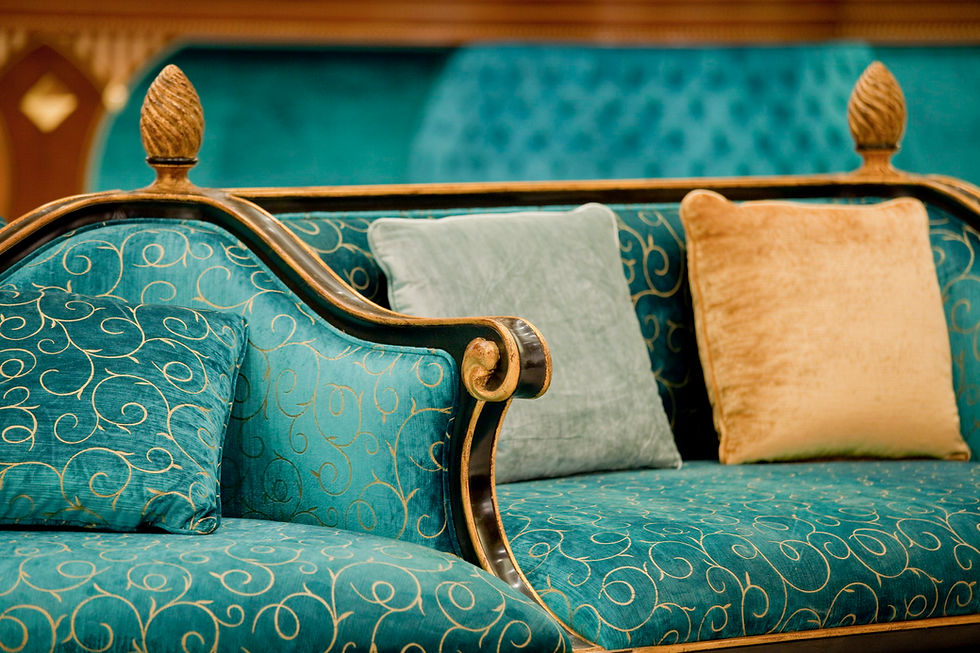
Textile development represents one of the most emblematic aspects of the project.
No fewer than 31,858 sqm of fabrics were required for the palace.
All original textiles came from the prestigious Maison Rubelli, the renowned Italian reference in exceptional textiles.
A large part of these fabrics was hand-designed by Maison Cartron specifically for Qasr Al Watan, giving the palace a unique textile identity.
These bespoke creations exist exclusively within the project.
The largest textile panel installed within the palace reaches spectacular dimensions:16 metres long by 4 metres high.
Beyond their decorative dimension, these fabrics actively contribute to the architectural atmosphere of the palace, its acoustics, lighting and monumental perception.
TABLEWARE BETWEEN FUNCTION AND REPRESENTATION
More than 90,000 pieces of tableware were selected for the palace.
A significant part of these elements was custom-designed by our Maison and produced by De Lamerie according to an exceptional level of craftsmanship.
Each piece was conceived as an extension of the palace’s interior architecture.
The objective was not purely functional. The tableware also contributed to the protocol dimension and the global identity of the project.
This attention paid to everyday objects illustrates Maison Cartron’s ambition to develop complete coherence between architecture, craftsmanship and use.
CONCLUSION
Qasr Al Watan remains one of the most emblematic projects in the history of our Maison.
Beyond its exceptional dimensions, the palace embodies a vision of interior architecture where monumentality, culture, craftsmanship and precision evolve in absolute continuity.
Through this project, Maison Cartron developed an approach to detail capable of expressing itself on an extraordinary scale while maintaining the same level of excellence as a bespoke-crafted piece.
From Paris to Abu Dhabi, Qasr Al Watan reflects our Maison’s ambition to create a dialogue between French craftsmanship, cultural identity and exceptional interior architecture.


Comments